New interactive tool: Explore housing policy impacts in Denver, Tucson, and San Diego
Communities across the United States are facing a growing housing affordability crisis, and we know that building more homes is part of the solution. Policies intended to spur new housing construction (like upzoning near transit, or reducing development fees) are gaining momentum around the country, but it can be hard to know which will really work.
We built the Terner Housing Policy Simulator to help researchers and policymakers model the potential impact of these changes. The Simulator uses local economic conditions, zoning rules, historical development patterns, and "development math" (the calculations developers use to determine if a project makes sense) to model how policies are likely to play out in a given city. Currently, the Simulator covers more than 20 cities around the country, with even more in development.
Today, we’re launching a new interactive tool which allows users to explore how a set of policies might play out in three cities (Denver, Tucson, and San Diego), offering a view into the Simulator’s potential for guiding data-driven policy decisions.
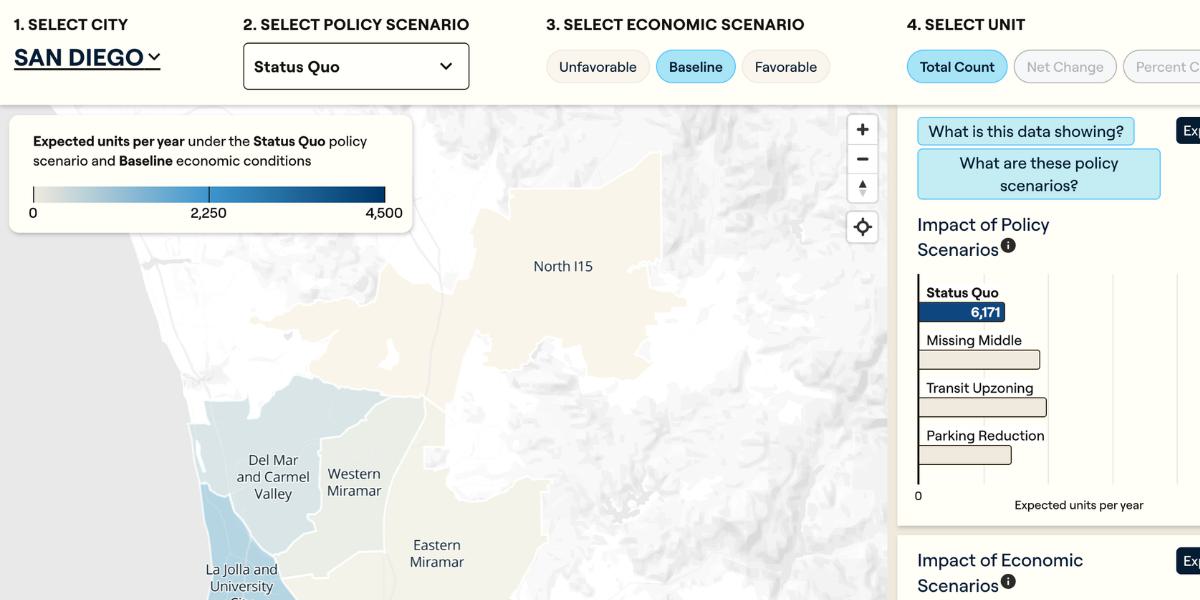
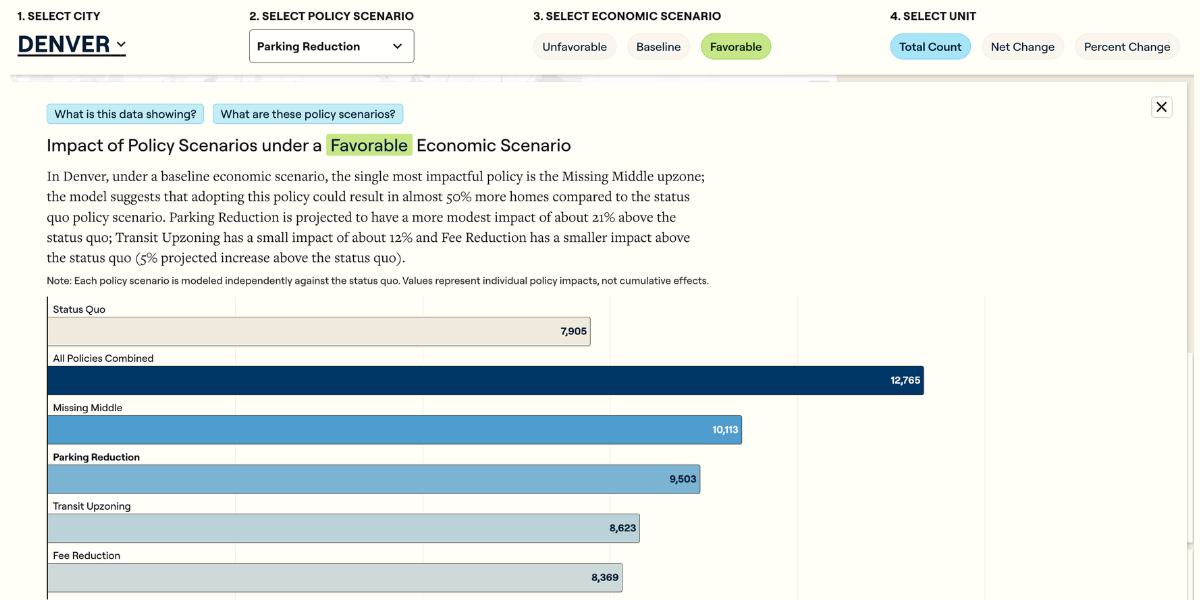
The Terner Center for Housing Innovation has published an analysis of the visualization’s findings, highlighting how local market conditions shape housing policy outcomes in the selected cities, and what policymakers in other cities and states might learn from the tool.
A key finding is that the same policy can produce dramatically different outcomes in different places. For example:
In Denver, missing middle upzoning produces large gains in new housing supply because many residential parcels are large enough to absorb additional units.
In San Diego, transit-oriented upzoning performs well because a large share of the city’s parcels are proximate to high performing transit.
In Tucson, while the increase in housing units is comparatively smaller, an all-of-the-above policy package of policy reforms leads to large increases to housing supply on a percentage basis.
Read the paper to learn more.